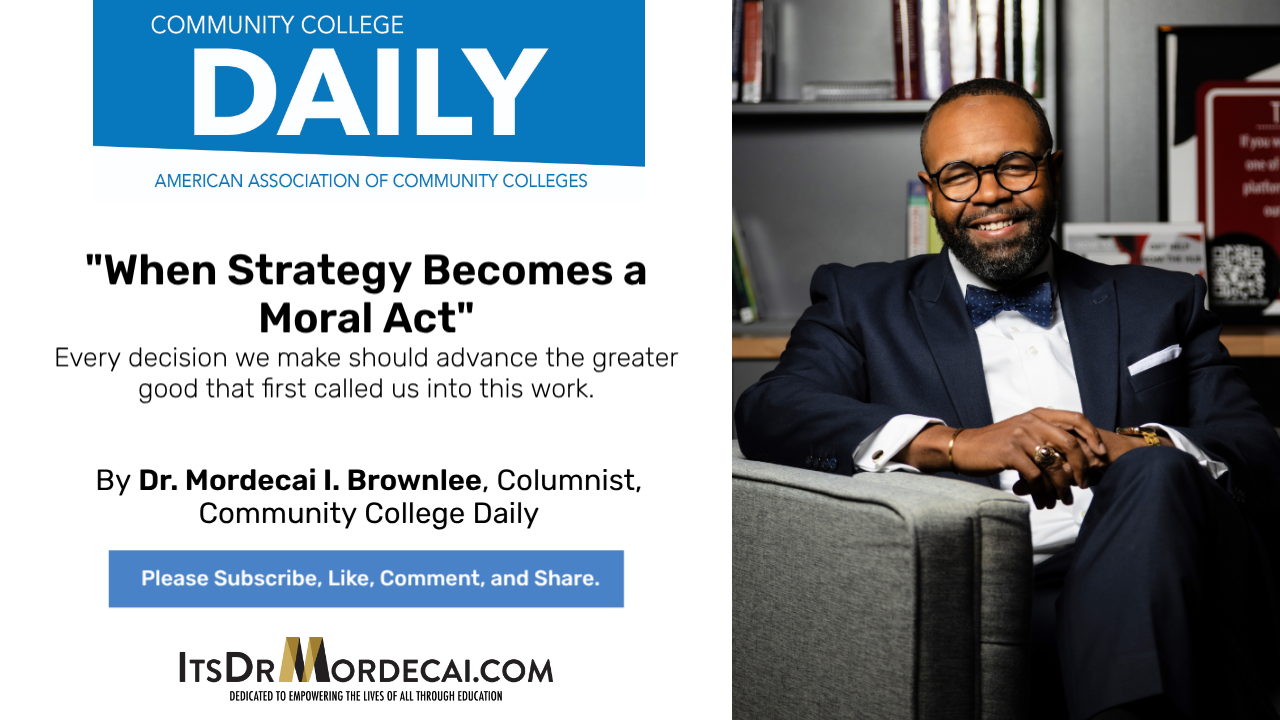
In his latest national column for Community College Daily, Dr. Mordecai Brownlee challenges higher education leaders to rethink the very nature of strategy.
What if strategy is not merely a roadmap for institutional success, but a moral decision?
In When Strategy Becomes a Moral Act, Dr. Brownlee invites educators, trustees, policymakers, and executive leaders to reflect on their “why.” At a time when institutions face enrollment pressures, fiscal constraints, political scrutiny, and shifting workforce demands, he argues that the most consequential decisions are not technical—they are ethical.
Strategy determines:
Who has access to opportunity
Which programs are prioritized
How resources are allocated
Whether institutions choose courage over comfort
For Dr. Brownlee, strategic planning is never neutral. It either advances upward mobility—or it maintains the status quo. It either expands belonging—or unintentionally reinforces barriers. It either serves communities—or protects systems.
This article continues Dr. Brownlee’s national conversation around purpose-driven leadership, institutional courage, and the responsibility community colleges carry as engines of economic mobility.
Higher education does not simply respond to change. It shapes the future. And strategy—when grounded in mission—is one of the most powerful tools leaders possess to do so.